Lab 01 - Imagining futures
With this lab, we will use the Building Utopia decks to design potential future human computer interfaces for some context.
To make things straightforward and serve multiple goals, we’re going to use this lab to start thinking through your final project, particularly imaging and desiging towards your alternative.

An Afrofuturist Speculative Design toolkit
The Building Utopia card deck is a really a set of decks built to lead you towards pathways of imaging alternative, equitable futures. Along these pathways you have the opportunity to explore beyond current limitations.
What is Afrofuturism?
There are a few ways people define afrofuturism. One useful definition is provided by Ytasha Womack:
“Afrofuturism is a way of looking at the future and alternate realities through a Black cultural lens. Black cultural lens means the people of the African continent in addition to the Diaspora, the Americas, Europe, etc. It is an artistic aesthetic, but also a kind of method of self-liberation or self-healing. It can be part of critical race theory and in other respects its an epistemology as well. It intersects the imagination, technology, Black culture, liberation, and mysticism. An an artistic aesthetic it bridges literature, music, visual arts, film, and dance. As a mode of self-healing and self-liberation, it’s the use of imagination that is most significant because it helps people to transform their circumstances. Imagining oneself in the future creates agency and it’s significant because historically people of African descent were not always incorporated into many of the storylines about the future.”
Important for us is the focus on imaging futures in ways that are conscious of the present, but can think beyond it!
The makers of the deck describe afrofuturism as something that “can both illuminate engagements in race in present-day social contexts and envision futures that incorporate Black aesthetic and possibilities.”
About the toolkit
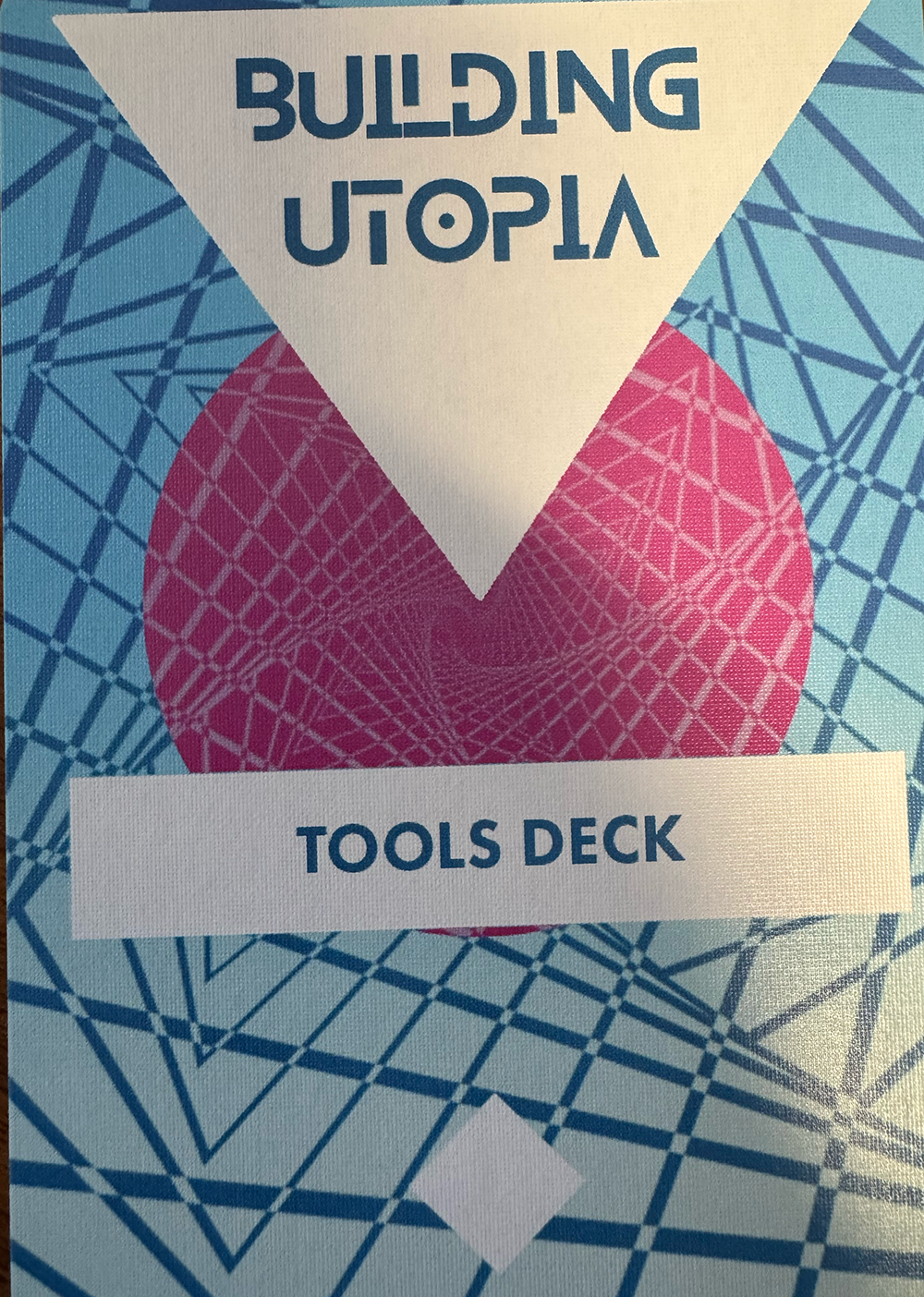
This toolkit consists of a deck, which itself is made up of five smaller decks of cards:
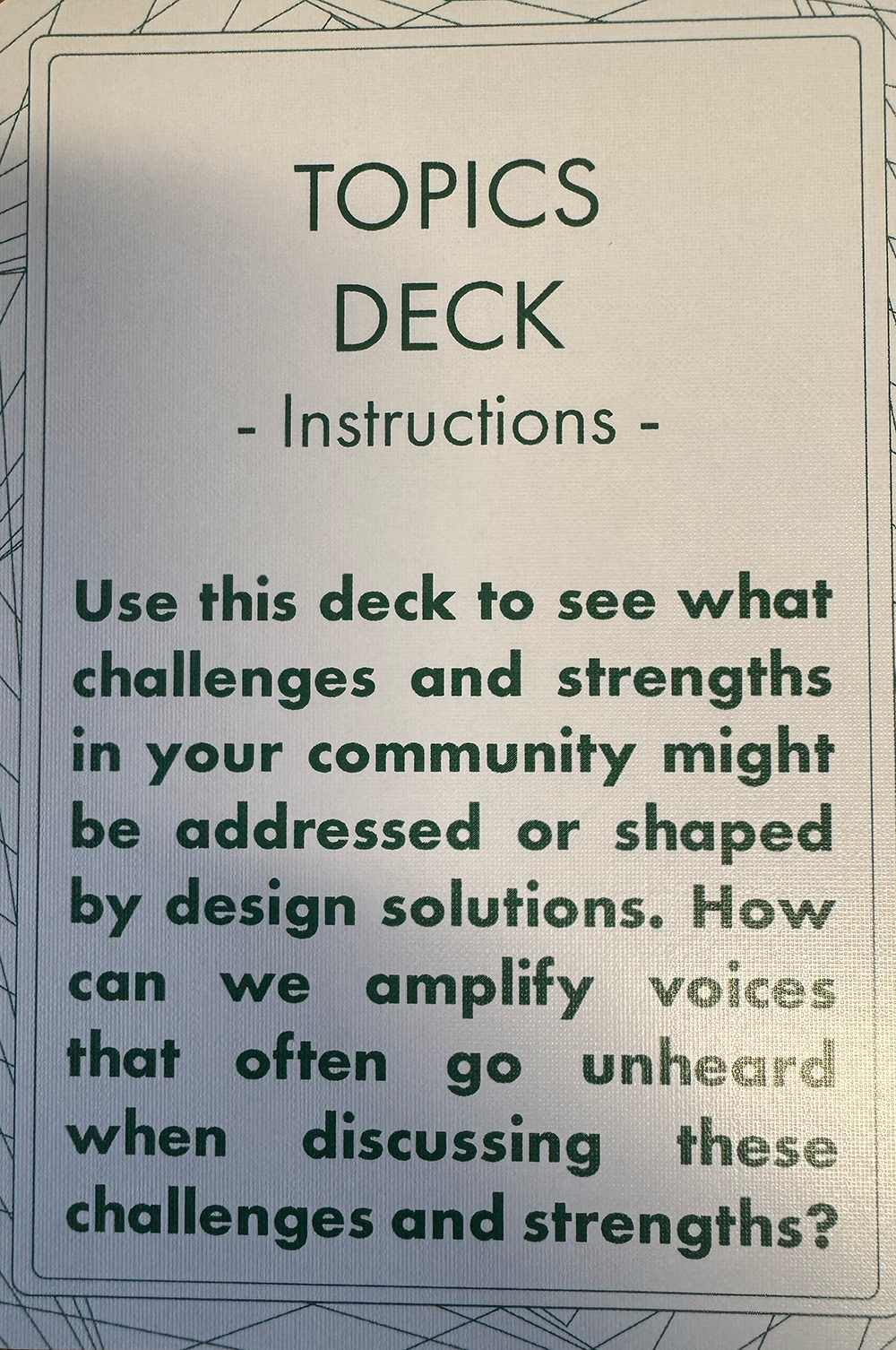
Topics
Can be used to understand challenges and strengths that might be addressed and/or shaped by design (human-computer interface designs in our case) pathways forward.
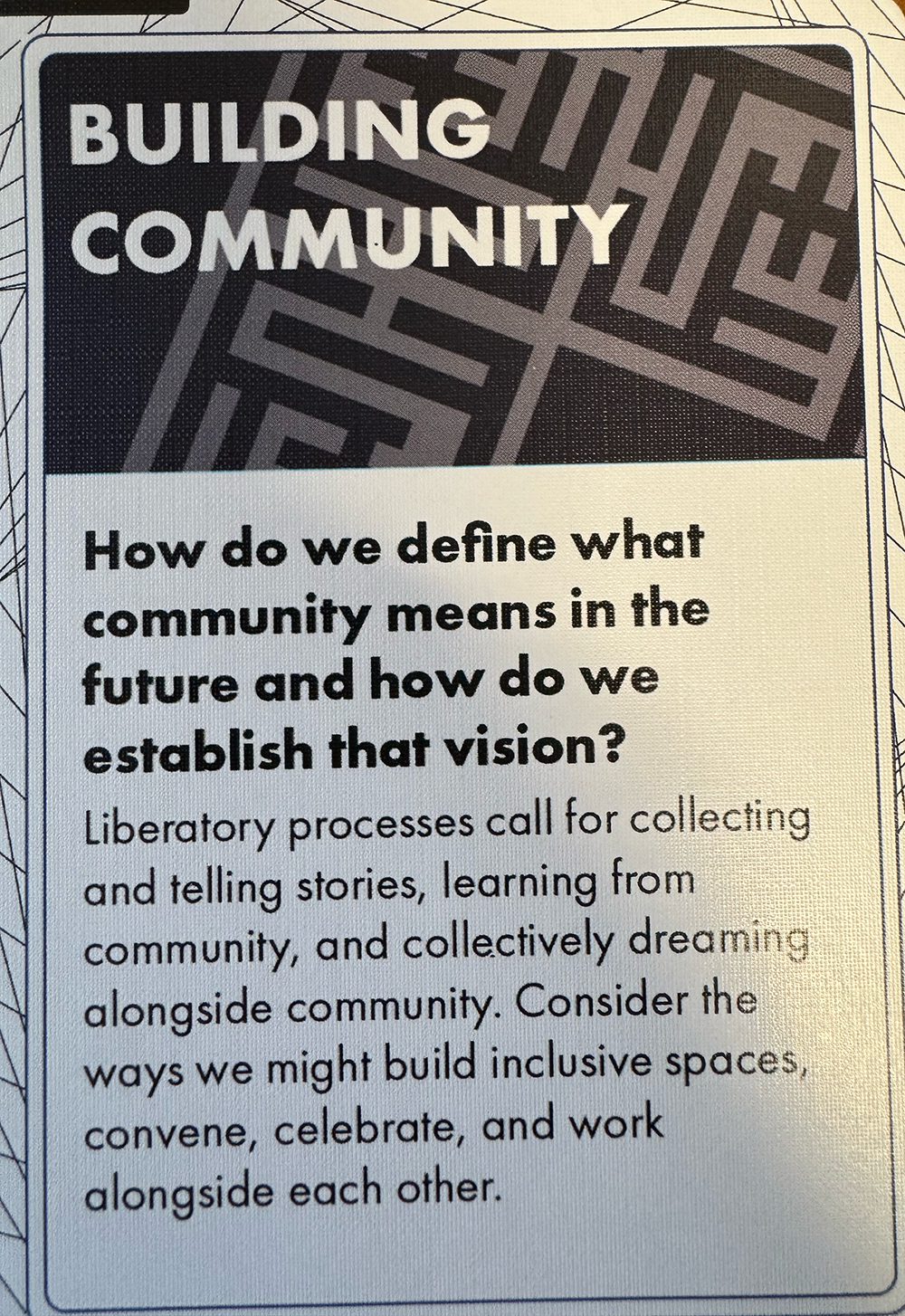
Liberation
Provides opportunities to consider ways that you/your selected community can live liberated lives and provides an opportunity to understand how values impact chosen pathways forward.
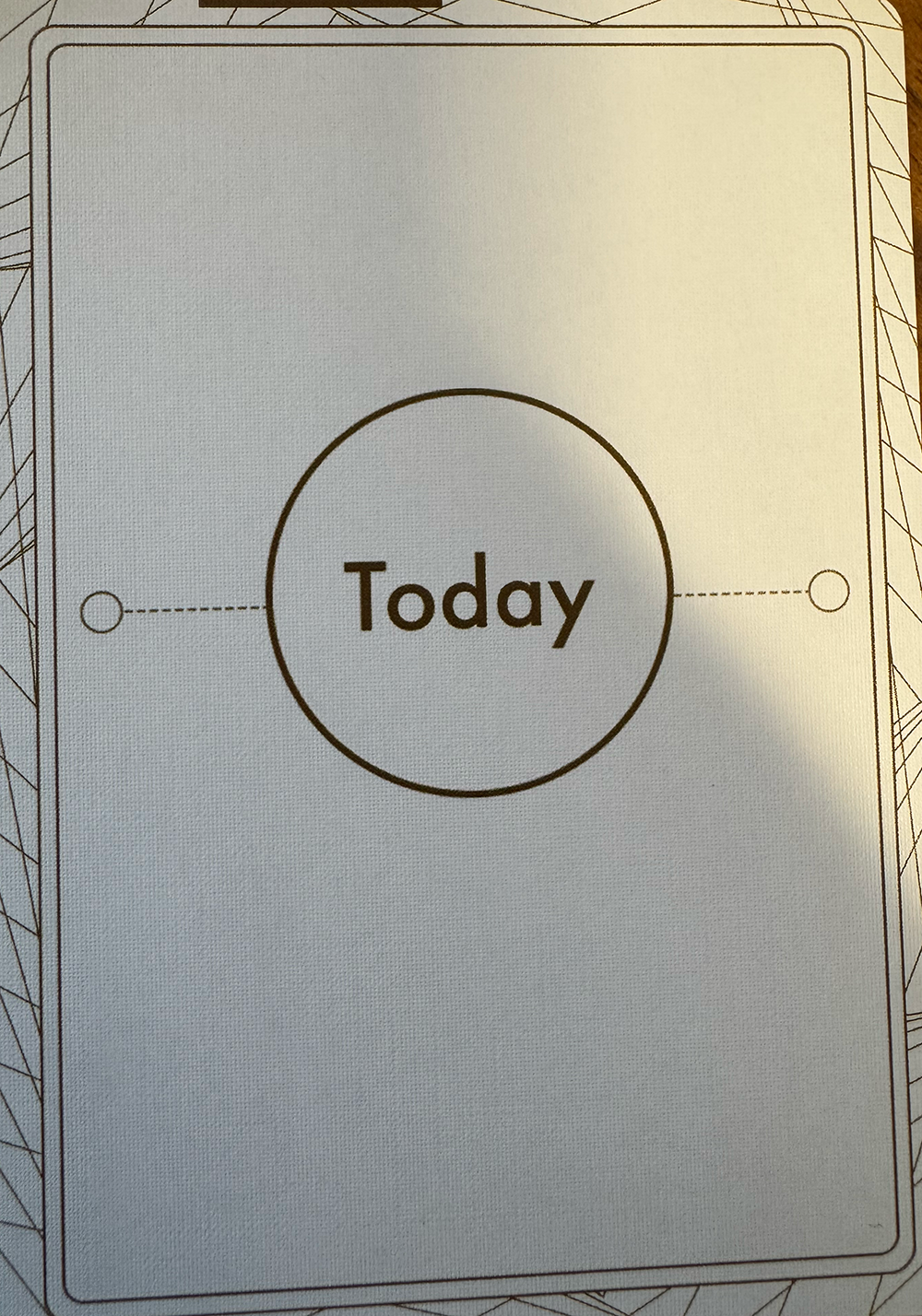
Forecasting
Provides possible timelines for future forecasting or to examine the past.
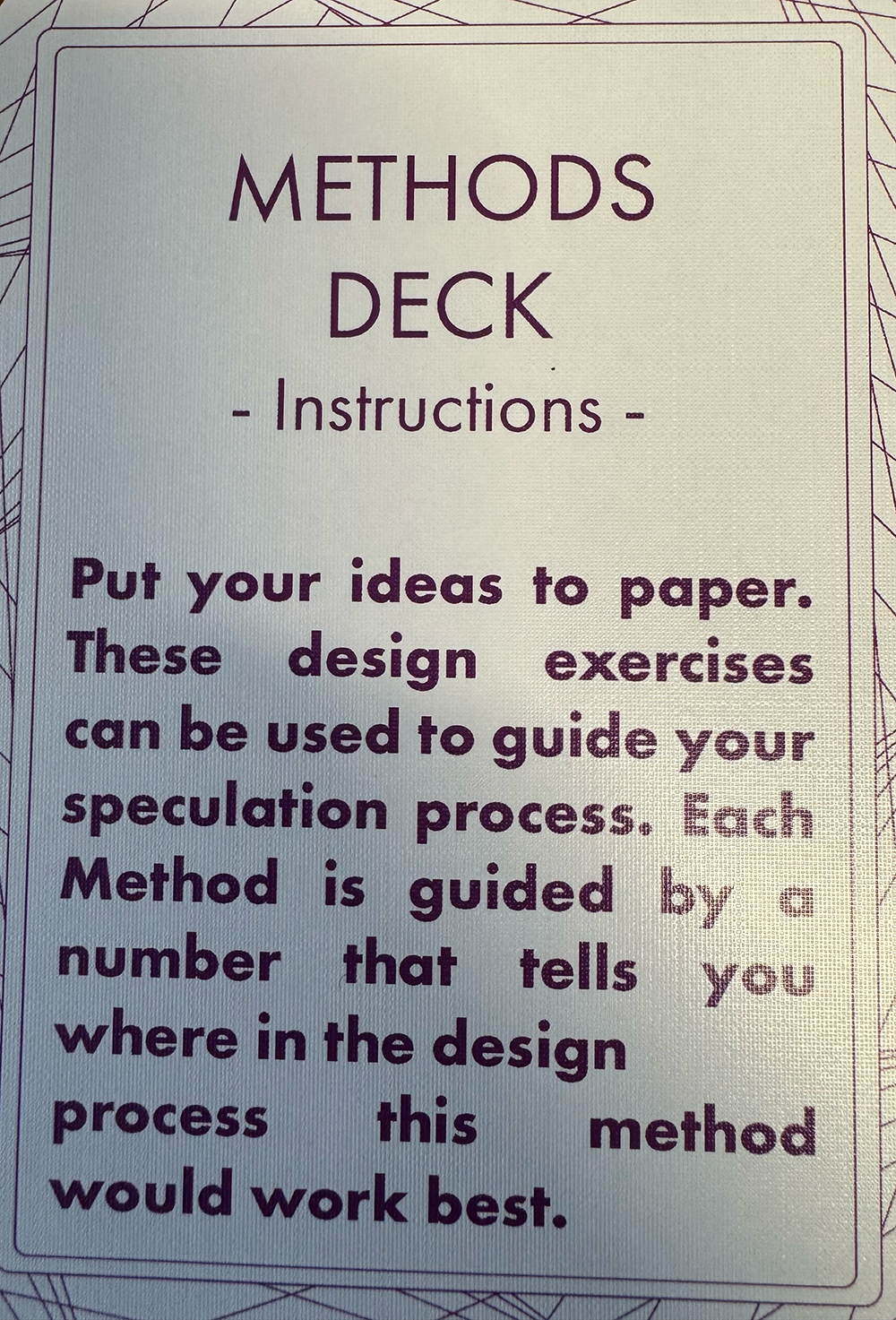
Methods
As the title suggests, provides methods and exercises that can be used to guide speculation processes.
Tools & Solutions
Offers opportunities to consider ways that liberation, joy, and community building can be encouraged in the future.
What are we doing in lab today?
Todays lab will be dedicated to having you start an initial design process for your chosen context/interface within your group. Don’t have the actual interface selected yet? No worries, we can use some time for that and you still will have wiggle room for adjusting your project over the next couple of weeks.
01: Prompts for considering liberation across time
During this section of lab, your group will consider one preconstructed prompt and select another from the Liberation and Forecasting decks.
01.a: Preconstructed prompt
What are your dreams from the future?
Reimagining equitable futures can be rooted in the dreams we have for ourselves and the communities we wish to serve. How does your group imagine the future of your interface and context in the next 5 years?
Task(s): Within your group sketch out (e.g., pen/paper) ideas. You can also write out ideas (thus both pictures and text are fine!)
First sketch out your ideas separately (each group member) then come back together and provide a consensus for an answer that will help you move your project forward.
Timing(s): For this task, take no more than 5 minutes for the individual portion, then no more than 10 minutes for discussion as a group and to come to a consensus.
What to report: Fill in your consensus idea in the lab report under the correct section (01.a in this case)
Make sure you also take the text/images from each individual group member and save it in your lab report appendix.
01.b: Selecting from several prompts
Forecasting liberation on your own
Here, you will, essentially, construct your own prompt and answer that prompt.
Tasks: As a group, select from the other possible cards in the Liberation deck. After you’ve made your seclection, select from any of the other possible cards in the Forecasting deck.
After you’ve settled on the prompt, within your group sketch out (e.g., pen/paper) ideas. As before, you can also write out ideas.
First sketch out your ideas separately (each group member) then come back together and provide a consensus for an answer that will help you move your project forward.
Timing(s): For this task, take no more than 5 minutes to select your cards, 5 minutes for the individual portion, then no more than 10 minutes for discussion as a group and to come to a consensus.
What to report: Record the cards selected/resulting prompt as well as your group consensus response to the prompt.
02: Using design methods to think through new possibilities
For this last part of the lab, we will use several cards from the methods deck to help guide our speculation processes and to hopefully set us up for interesting projects this semester.
02.a: Identifying challenges
Here, we will use the “How will we” card to explore challenges
Task(s): Follow the instructions on the “How will we” method card. Here, you can use the computer instead of paper (for example, a google doc could be useful if you haven’t been using one already).
Timing(s): For this task, follow the card suggestion - 15 minutes.
What to report: Pick 2 salient “How will we” statements and explain why those were salient within your group under the correct section.
Make sure that you record each “How will we” statement, the full list of which should go in your relevant appendix.
02.b: Thinking of the future
Here, we will use the “Radical future ideation” card to explore potential new pathways without constraints
Task(s): Follow the instructions on the “Radical future ideation” method card. Make sure to follow instructions and use the results from the previous “How will we” section to seed the potential pathways you seek. Remember the “without limits or constraints” part of this method!
Timing(s): For this task, we are going to have a slightly shorter time - 5 minutes.
What to report: Pick 3 salient pathways (“solutions”) and explain why those were salient within your group under the correct section.
Make sure that you record each solution, the full list of which should go in your relevant appendix.
02.c: Iteratively expanding pathways
Here, we will use the “Yes and” card to explore features of potential new pathways and add to those as a group
Task(s): Follow the instructions on the “Yes and…” method card. Use the pathways (solutions) from the previous section (particularly the two most salient solutions) to seed your feature generation. Make sure to follow instructions and start with individual solutions.
Timing(s): For this task, we’re generally following the suggestion on the card (but we can skip solution generation) - 5 minutes for feature generation (individual) and 5 minutes for the group-based “yes and…” sharing portion.
What to report: Pick 3 salient individual features discussed, provide the additional “yes and” features discussed, and explain why those were salient within your group under the correct section.
Make sure that you record each feature and “Yes and” statement, the full list of which should go in your relevant appendix.
02.d: Challenging Assumptions
Here, we will use the “Challenge Assumptions” card to explore asumptions we might have made in selected solutions and features (from the previous sections)
Task(s): Follow the instructions on the “Challenge Assumptions” method card. Use the pathways (solutions) and features of those pathways from the previous sections (particularly the two most salient solutions along with the three most salient features of those solutions) to seed the questions asked on the challenge assumptions card.
Timing(s): For this task, you should follow the suggested 10 minute timing on the card with roughly 5 minutes split between the two salient pathways/solutions.
What to report: Pick (at least) 1 salient assumption discusse, the answer to the 2nd question for that assumption, and explain why that assumption was salient within your group under the correct section.
Make sure that you record each assumption and the corresponding answer(s) to the 2nd question, the full list of which should go in your relevant appendix.
What is a reasonable lab report length?
The lab report (not including the appendices) should be 3-7 pages.
How is my lab graded?
| Graded item | Number of points |
|---|---|
| Introduction | 3 pts |
| Lab section 01a | 3 pts |
| Lab section 01b | 3 pts |
| Lab section 02a | 3 pts |
| Lab section 02b | 3 pts |
| Lab section 02c | 3 pts |
| Lab section 02d | 3 pts |
| Conclusion and next steps | 3 pts |
| Appendix 01 | 6 pts |
| Appendix 02 | 6 pts |
| Total points possible | 36 pts |